


More Than Behavior: The Hidden Skills Behind Everyday Childhood Success
How emotional regulation, sensory processing, executive functioning, and motor development all work together to shape your child's everyday participation.
Every parent has experienced moments that leave them scratching their head.
"Why does getting dressed take 30 minutes every morning?"
"Why does homework end in tears every single night?"
"Why does my child completely fall apart after school?"
"Why do I have to remind them the same thing over and over?"
"Why is brushing teeth such a battle?"
Maybe you've even caught yourself wondering...
"Are they just being stubborn?"
"Are they just not trying?"
Or maybe you've heard comments from well-meaning friends or family members:
"They just need more discipline."
"They're old enough to know better."
"You just have to be more consistent."
As a pediatric occupational therapist, I can tell you that there is often so much more happening beneath the surface than what we see.
Behavior is what gets our attention.
But behavior is rarely the whole story.

Behavior Is the Tip of the Iceberg
One of my favorite ways to explain this is by thinking of an iceberg.
Above the water is everything we notice first.
Tantrums
Refusing homework
Difficulty following directions
Meltdowns during transitions
Constant movement
Poor handwriting
Impulsivity
Emotional outbursts
These behaviors are real.
But they're often the symptom—not the cause.
Beneath the surface are the hidden skills that help children successfully participate in everyday life.
When one or more of those skills are still developing, behavior is often how children communicate that something is hard.
Instead of asking,
"How do I stop this behavior?"
try asking,
"What skill might my child be struggling with?"
That single question can completely change the way we support children.
Emotional Regulation: The Foundation for Learning
Children aren't born knowing how to manage frustration, disappointment, excitement, or anxiety.
Those skills develop over time through supportive relationships, practice, and co-regulation with trusted adults.
Think about the last time your child had a meltdown.
Were they trying to make your day harder?
Probably not.
Their nervous system was overwhelmed.
When children become dysregulated, their brains shift into survival mode.
Learning.
Listening.
Problem-solving.
Following directions.
Even using words...
all become much harder.
Supporting emotional regulation doesn't mean preventing children from experiencing difficult emotions.
It means helping them learn how to move through those emotions successfully.
Sensory Processing: How Children Experience the World
Every child experiences the world differently.
Some crave movement.
Others avoid it.
Some cover their ears during birthday parties.
Others are constantly jumping, spinning, crashing, or climbing.
Some refuse certain clothing.
Others chew on everything they can find.
Sensory processing isn't simply about preferences.
It's about how the brain receives, organizes, and responds to sensory information.
When sensory processing becomes challenging, it can affect:
attention
emotional regulation
motor skills
learning
social participation
everyday routines
Sometimes what looks like "bad behavior" is actually a child's nervous system asking for support.
Executive Functioning: The Brain's Management System
Executive functioning is like the brain's air traffic controller.
It helps children:
remember directions
start tasks
stay organized
manage time
control impulses
shift between activities
regulate emotions
finish what they started
When these skills are still developing, children might:
forget homework
lose backpacks
struggle to begin assignments
need frequent reminders
become overwhelmed by multi-step tasks
That doesn't mean they're lazy.
It means they're still developing the brain skills needed for independence.
Like reading or riding a bike, executive functioning improves through practice, repetition, and support.
Motor Skills: Much More Than Handwriting
When people hear "occupational therapy," handwriting is usually the first thing they think about.
While handwriting is important, motor skills influence nearly every part of childhood.
Motor skills help children:
get dressed
brush their teeth
use utensils
play on the playground
ride a bike
participate in sports
build with LEGOs
complete classroom activities
They also play a huge role in confidence.
Children naturally want to participate alongside their peers.
When everyday tasks consistently feel harder, children often begin avoiding them—not because they don't want to participate, but because participation feels difficult.

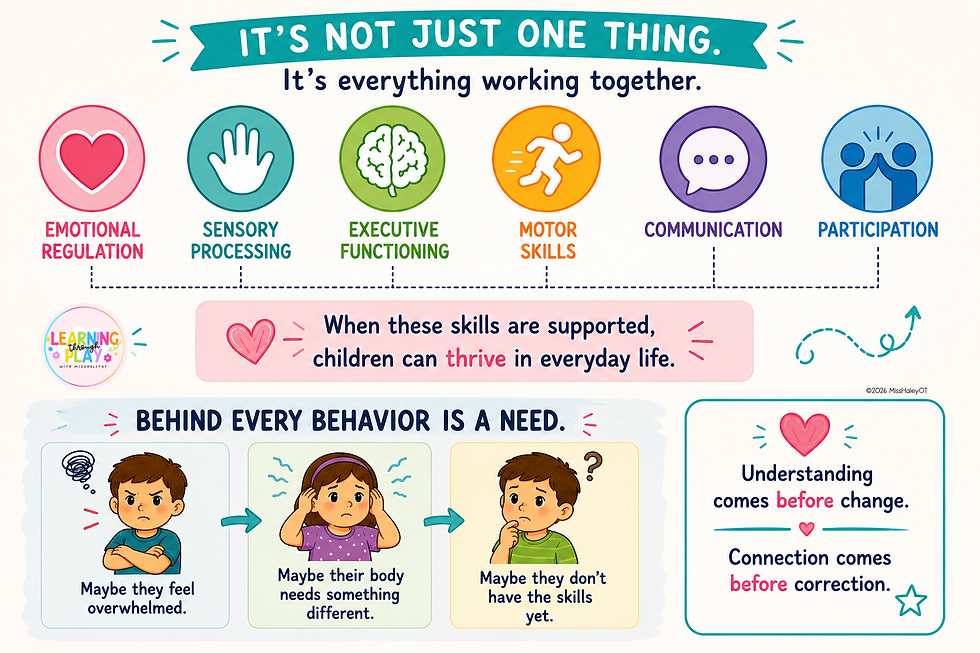
It's Never Just One Skill
One of the biggest misconceptions I hear is:
"My child just has sensory issues."
Or...
"It's only attention."
In reality, children are wonderfully complex.
A child who struggles with transitions may also be working hard to regulate emotions.
A child with poor handwriting may also have challenges with motor planning, posture, visual motor integration, or executive functioning.
A child who avoids the playground may actually be struggling with balance, confidence, sensory processing, or motor coordination.
These skills don't exist in isolation.
They constantly influence one another.
When we support one area, we often strengthen several others at the same time.
The Goal Isn't Perfect Behavior
As occupational therapists, our goal has never been perfect behavior.
Our goal is participation.
Can a child successfully participate in family routines?
Can they play with friends?
Can they enjoy school?
Can they become more independent during everyday activities?
Can they build confidence while doing the things that matter most?
Participation is where childhood happens.
It's where relationships grow.
It's where confidence develops.
It's where meaningful memories are made.
When we focus only on changing behavior, we risk missing the skills children actually need.

Progress Over Perfection
One of the biggest lessons I hope every caregiver takes away is this:
doesn't always look dramatic.
Sometimes progress looks like...
Needing five reminders instead of ten.
Recovering from disappointment in five minutes instead of thirty.
Trying a new food after months of refusing it.
Asking for help instead of melting down.
Putting shoes on independently for the first time.
Joining the playground instead of watching from the sidelines.
Those moments matter.
Those are victories.
Growth isn't measured by perfection.
It's measured by consistent progress over time.
Celebrate every step forward.
Looking Beneath the Surface
The next time your child struggles, pause before asking,
"Why are they behaving this way?"
Instead, try asking,
"What might be hard for them right now?"
That small shift changes everything.
It moves us away from blame and toward understanding.
Away from frustration and toward curiosity.
Away from simply managing behaviors and toward building the skills children need to thrive.
Because behavior is only one chapter of the story.
The real story—the one that leads to confidence, independence, and meaningful participation—is happening beneath the surface.
And when we take the time to understand those hidden skills, we aren't just changing behaviors.
We're changing lives.


Comments